FOOTPATH  SCENES  AND  SPECIMENS

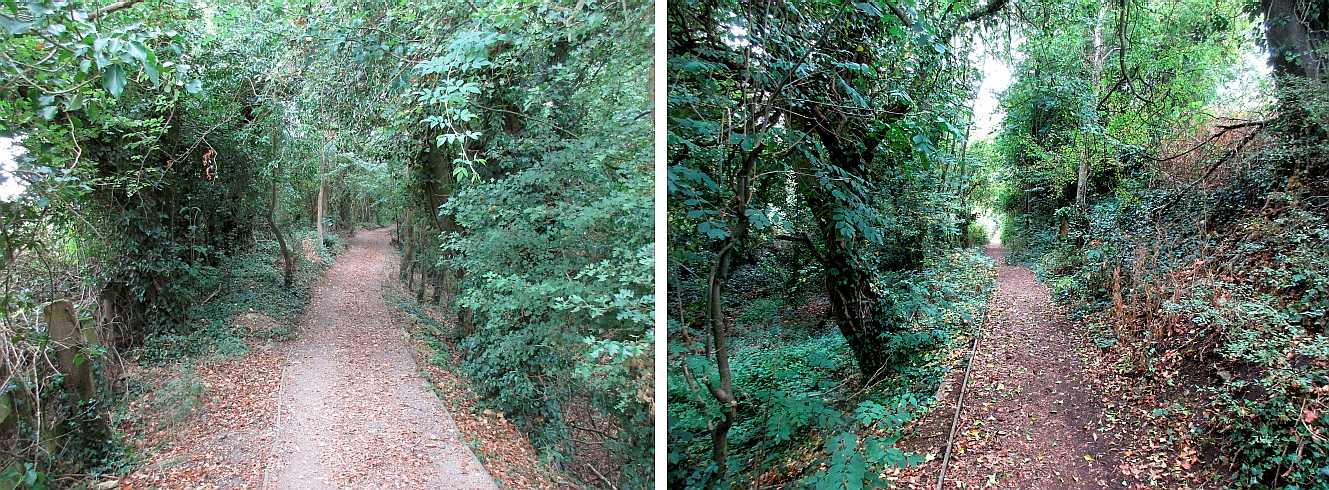
The towpath in summer.
When the Thames and Severn Canal was functional this would have been the towpath - the route for the horses to take when pulling the narrowboat barges.  They were the heavy goods vehicles of their day, but many of them would also have provided live-aboard accommodation for whole families.
Of course none of this tall, heavy vegetation would have been here: the canal would have been cut through fields open on both sides.  Now the path is almost roofed over by wild-grown trees and shrubs.

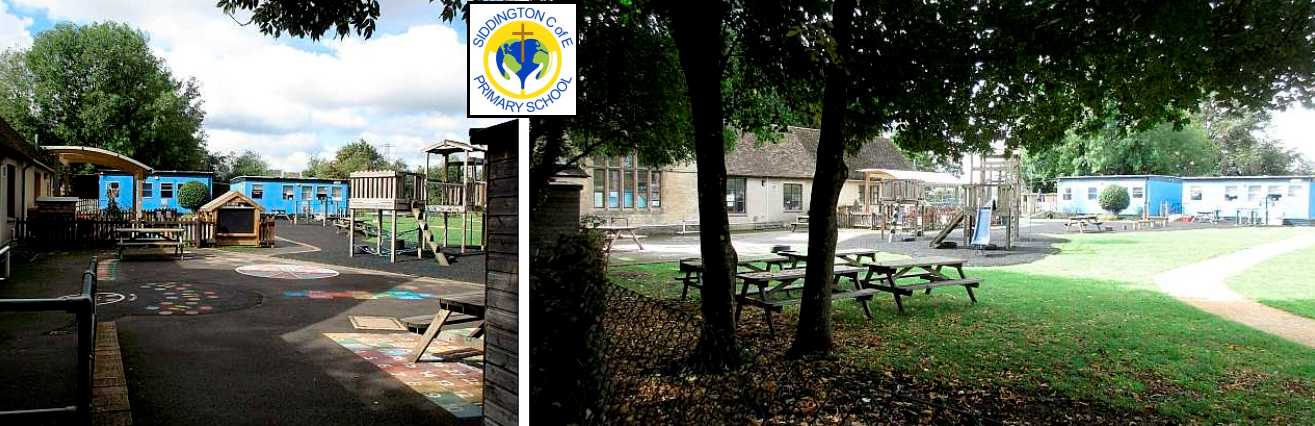
Siddington School.
Siddington Church of England Primary School is a feature of the western arm of the footpath circuit.  Its stated aim is "To have fun, do our very best and look after everyone in a caring Christian community".  Photographed in September of 2022, it seemed to be well equipped to do that but plans were afoot for developments, including a new multi-purpose hall, to cope with the population increase from local housing expansion.

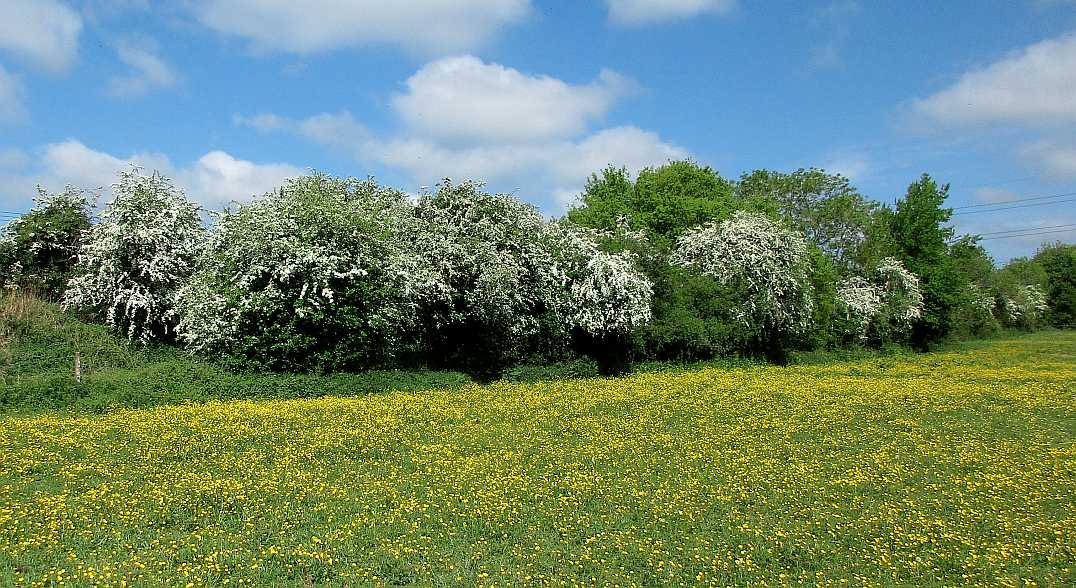
Hawthorn and buttercups.
FIELD  AND  BANK  FLOWERS

Just one field away from the once-upon-a-time canal, the footpath passes through a brick-lined gap in the bank of a once-upon-a-time railway line.  That gives access to the horse-pastures' springtime (mid-May) profusion of buttercups with a white floral background of the bank's self-sown hawthorn bushes.

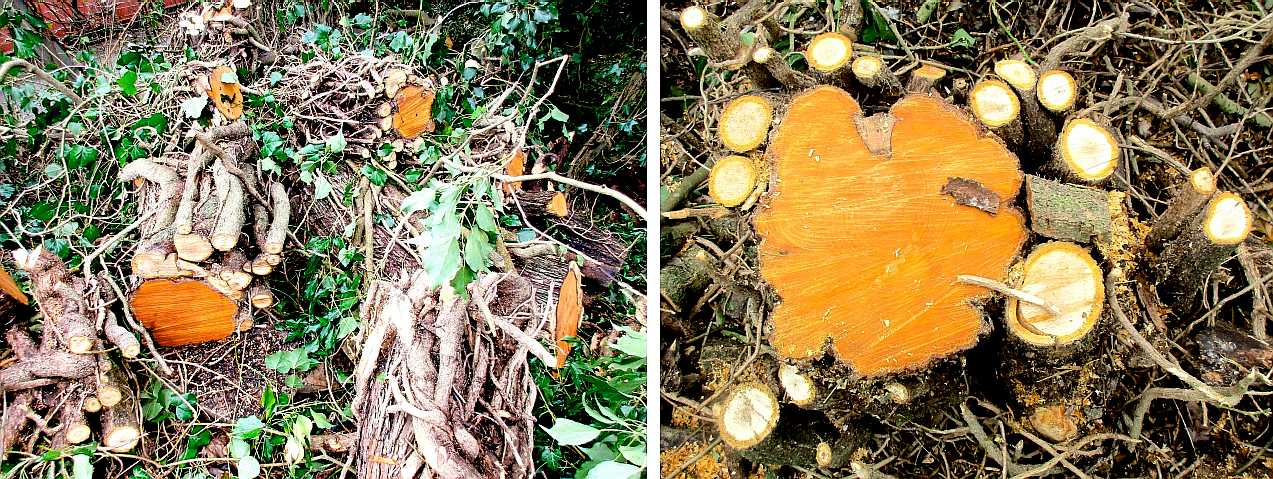
A tree stump with ivy. TREE  STUMP  with  IVY

A venerable hawthorn growing too close to the fence was felled.  Its stump shows that a long-established ivy plant can contribute almost as much carbon-captured wood as the host had done.

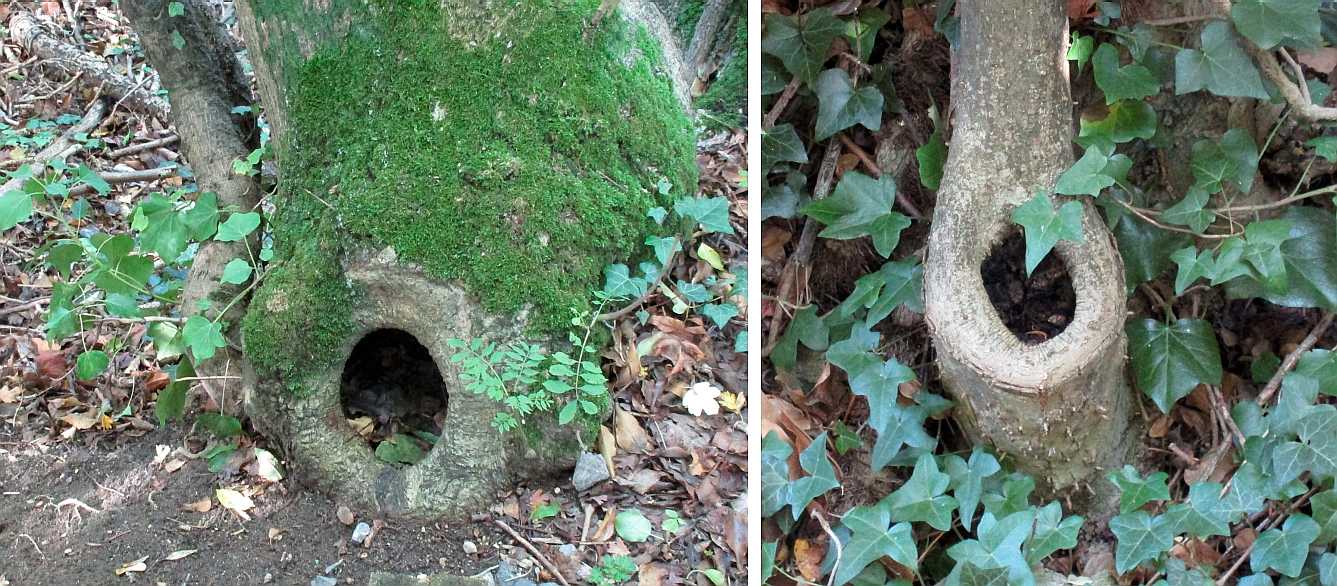
Holes in trees.
When a tree loses a limb the breakage may rot away while the edges of the healthy wood tissue carry on growing, now as a rim round the affected area.  The resulting hole may well be used by anything from creepy-crawlies to a woodpecker - though perhaps not where the site is so low to the ground and as close to the path as these examples: a mouse-hole perhaps?

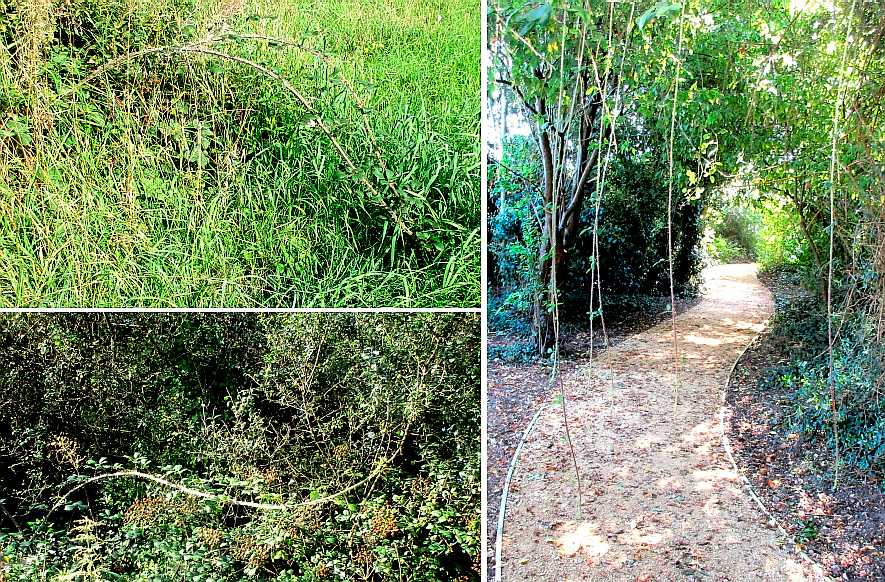
Extended bramble stems.
Brambles are amazing!  Along a hedge line they can form dense impenetrable thickets.  But a stem on the edge of the thicket may drop down and root at its tip - that's how the thicket enlarges itself.  They can also send their stems shooting upwards in search of extra sunlight.  In woodland the bramble uses trees for support, eventually tipping over and extending more economical exploring stems growing downwards, hoping to reach the ground where they can take root and thus establish more new plants (unless a footpath volunteer snips them off, of course).

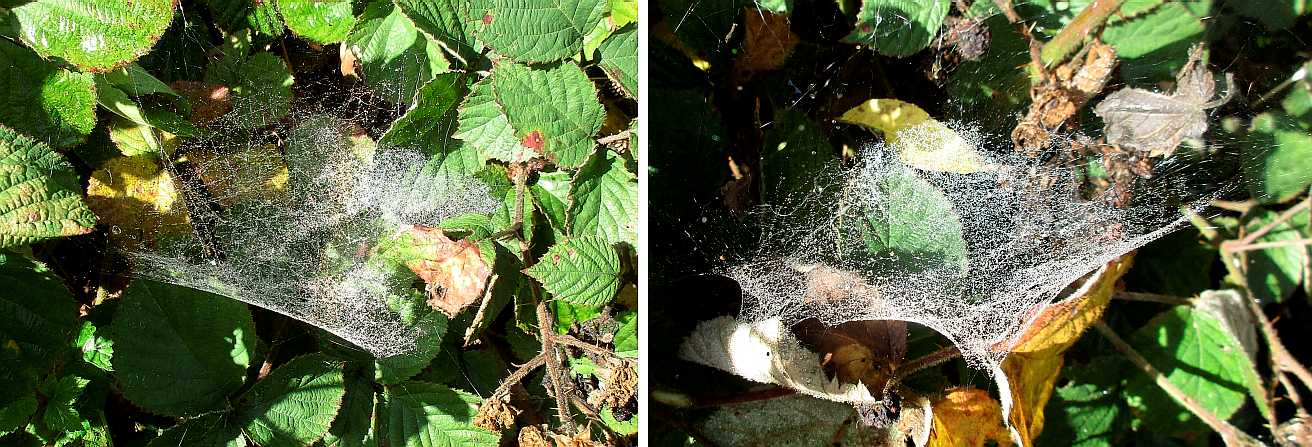
Spider webs.
A bright but damp autumn morning shows up condensation on spiders' webs.  Normally thought of in terms of the familiar circular fly-catching structures, strands and webs of countless different varieties are produced by different species of spiders for a whole range of uses.

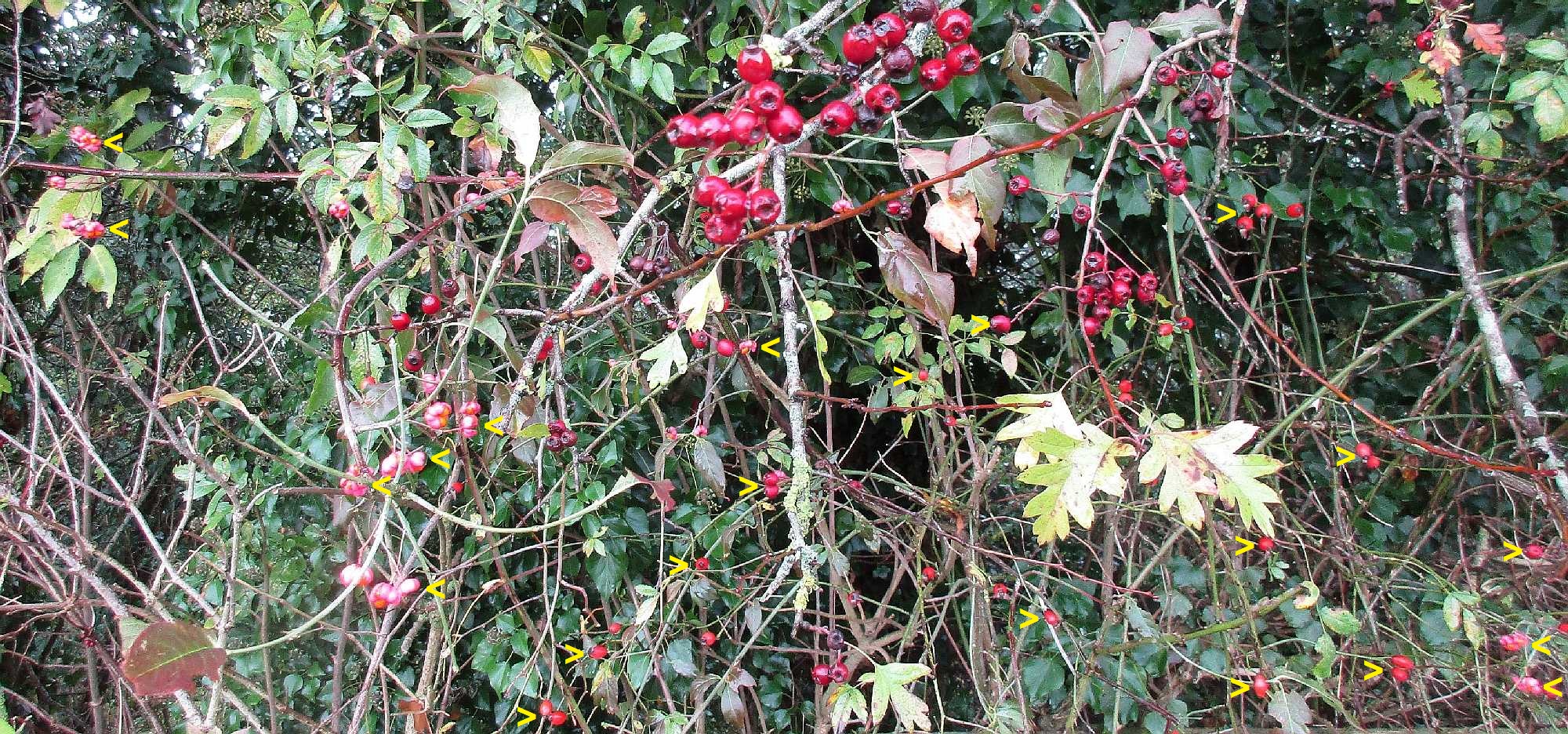
Hips, haws and spindle fruits.
Lots of hawthorn haws in early November, plus smaller numbers of >rose hips> and <spindle fruits<.

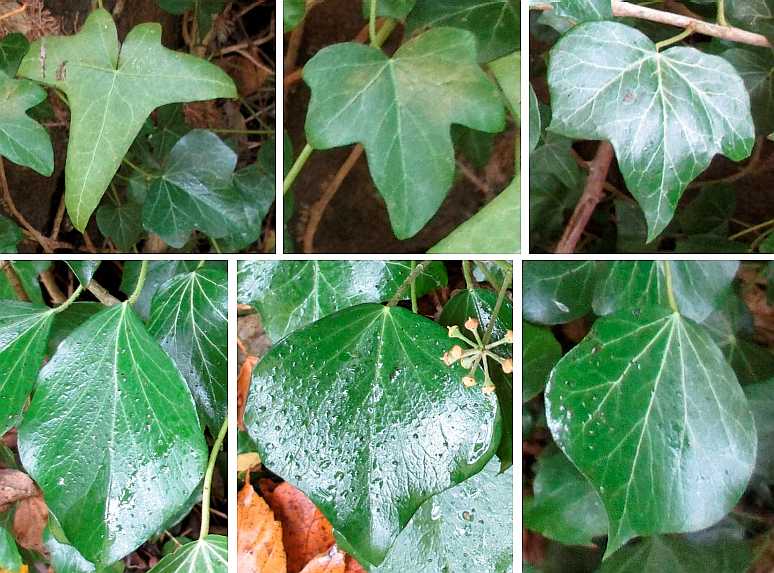
Various shapes of ivy leaves. With most kinds of trees and bushes and indeed plants of all kinds, it's possible to identify the species from the shape of the leaves, all controlled by genes inherited from earlier generations.  So the situation with ivy is rather strange: it can have many different shaped leaves all on any one plant.

Ivy flowers with visitors. SURPRISES !

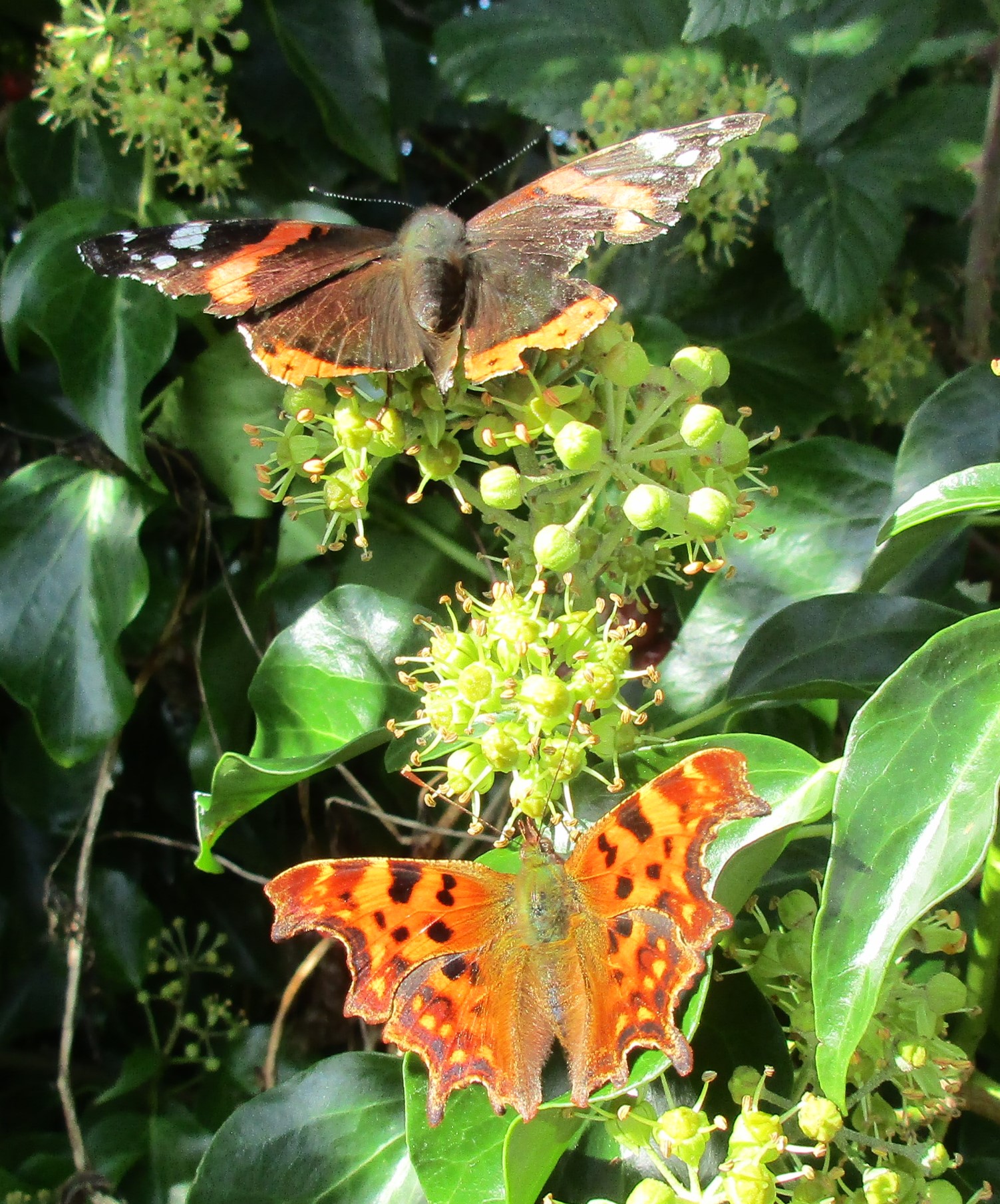
< LEFT • Ivy produces lots of nectar-rich flowers in the early autumn.  Being so late in the season there's no need for any pretty petals to attract insect pollinators such as these two butterflies, a red admiral above and a comma below.

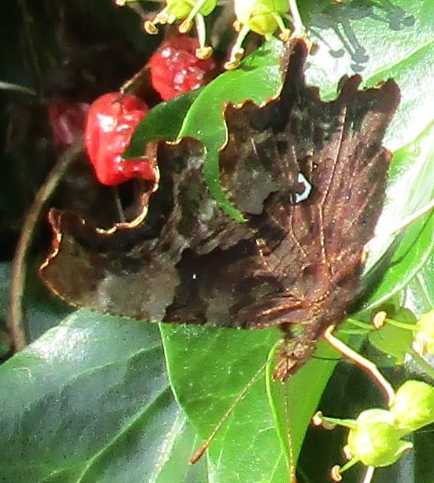
RIGHT > • That brown splodge is not a dead leaf caught on the living hedge.  No, it's the closed-wings or underwing view of another orange and black comma butterfly.  A careful look reveals its ragged outline and even its characteristic little white 'comma' marking.  Its antennae look more like veins of the host leaf.

Photographed in late September.
Comma underwing.

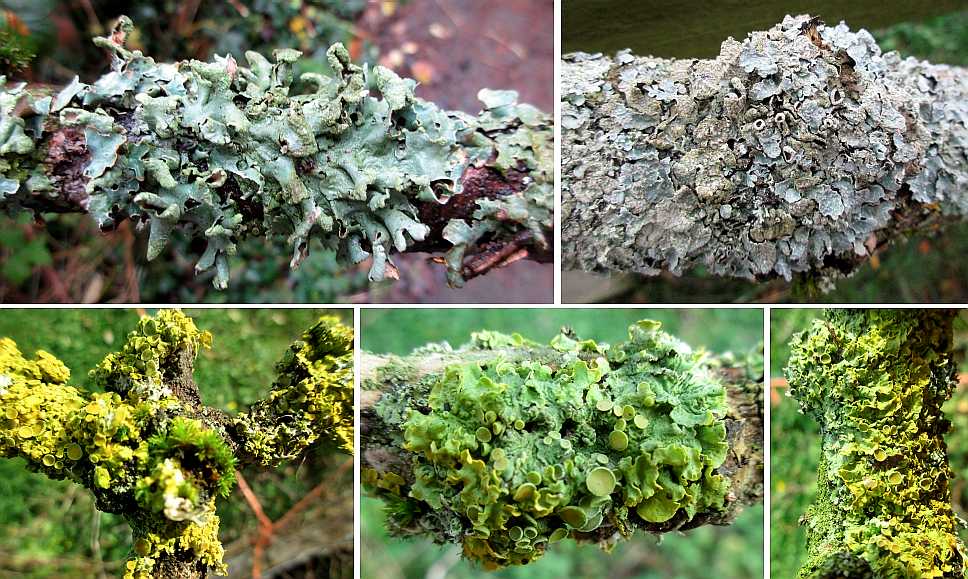
Specimens of lichens.
Lichens [usually pronounced LIE-kns] are plant-like growths found growing on rocks, tree bark and most particularly on rotting wood including, as shown here, on twigs.  They may be blue, or green, or yellow - even red, though not seen on this footpath.  Each type consists of one kind of alga combined with a partner fungus (but not looking like either of them).  Nobody plants them: they appear whenever their microscopic seed 'spores' find a suitable lodging place.  Those spores are carried on any breeze, having been produced in special structures such as those circular mini-dishes.  The British Lichen Society website includes masses of details, listing just 99 identifiable UK species!

Our home page   •   Plants   •   Fungi   •   Animals   •   Seasons   •   Updates